Free Yes or No Tarot Guide: How to Frame Questions, Read Reversals & Decode Polarity
A free Yes or No Tarot reading works best when you ask one clear, time-bound question rather than a vague double-bind. Across a 78-card deck, upright cards signal direct momentum—such as The Sun (Yes) or The Tower (No)—while reversed cards frequently shift into "Wait," "Pause," or "Unclear" so you avoid premature choices.
Searching for a free yes or no tarot draw usually happens at a moment of impatience: a message sits half-typed, a lease or job offer has a deadline, or your intuition feels split down the middle. One-card polarity readings cut through noise rapidly—provided you understand two mechanics most shallow sites hide: how a 78-card deck actually maps Yes, No, Wait, Pause, and Unclear, and why question phrasing determines whether the card makes any sense.
In our Free Yes or No Tarot tool, every single one of the 78 Major and Minor Arcana cards carries distinct upright and reversed verdicts instead of forcing every pull into a coin-flip binary. That five-state polarity reflects how real decisions unfold: sometimes the honest answer is not "No forever," it is "Pause until you verify the hidden clause."
How Five-State Yes / No Polarity Works Across the 78-Card Deck
If a tarot app reduces all 78 cards to strict 50/50 Yes or No labels, it destroys the deck's richest diagnostic signals. Consider The High Priestess: her archetype is quiet observation behind the veil. Calling her an unconditional "Yes" violates her symbol; in our engine, upright High Priestess returns Wait, and reversed returns No because forcing an answer while ignoring your own gut rarely ends well.
Even more illuminating are cards whose polarity flips cleanly when inverted. Look at the Minor Arcana Fives—such as Five of Swords—which signify friction, ego clashes, or passing storms. Upright, a Five leans No (do not escalate a losing fight right now). Reversed, it shifts to Yes because the peak tension is clearing behind you.
Verified Yes / No Polarity Reference Table
The reference table below shows exact upright and reversed polarities drawn from Zodiac Traits' 78-card Rider-Waite-Smith engine so you can verify why a yes no tarot ai verdict reads the way it does.
| Card | Arcana / Element | Upright Verdict | Reversed Verdict | Core Reading Nuance |
|---|---|---|---|---|
| The Sun (XIX) | Major · Fire | Yes | Yes | Warm clarity; reversed merely notes delayed visibility or lingering self-doubt |
| The Magician (I) | Major · Air | Yes | Unclear | Full leverage upright; scattered focus or mixed motives when reversed |
| The Lovers (VI) | Major · Air | Yes | Pause | Alignment upright; unspoken asymmetry requires honest dialogue first |
| Wheel of Fortune (X) | Major · Fire | Yes | Wait | Turning cycle favors action upright; let shifting conditions settle if reversed |
| The High Priestess (II) | Major · Water | Wait | No | Essential facts remain below the surface; resist rushing |
| The Hermit (IX) | Major · Earth | Wait | Yes | Quiet solitude needed first upright; emerging out of isolation reversed |
| The Hanged Man (XII) | Major · Water | Wait | Yes | Suspension brings new perspective upright; stalemate breaks reversed |
| Death (XIII) | Major · Water | No | Wait | An old chapter is closing upright; hesitation prolongs transition reversed |
| The Tower (XVI) | Major · Fire | No | Pause | Unstable structure cannot hold; clear the cracks before rebuilding |
| The Moon (XVIII) | Major · Water | Unclear | Yes | Fog and projection upright; illusion dissolves as truth clears reversed |
| Minor Arcana Fives (all 4 suits) | Minor · All Elements | No | Yes | Active friction upright; storm passing and calm returning reversed |
Notice a striking pattern across the Minor Arcana: Aces such as Ace of Wands return Yes upright because an authentic spark has appeared, yet shift to Pause reversed—confirming that the potential is real while your groundwork needs one more week of preparation. Similarly, Court Cards carry nuanced authority: upright Queens and Kings across all four suits lean Yes because mature mastery supports action, while reversed Queens ask you to Pause and replenish boundaries, and reversed Kings flip to No when rigid control or impatience is steering the wheel.
Two Worked Examples: How Reversed Nuance Saves You From Costly Timing Errors
Abstract rules click fastest when tested against real dilemmas. Consider two typical one-card draws inside Yes or No Tarot:
- Scenario A — Career Offer Deadline: You ask, "Should I sign this partnership contract before Friday without renegotiating the revenue split?" You draw The Magician (Reversed). Because the verdict is Unclear rather than an automatic Yes, you know persuasive charisma or flashy promises may be masking missing deliverables. Instead of walking away forever or signing blindly, you spend forty-eight hours requesting written milestones.
- Scenario B — Reconciling After Tension: You ask, "Is reaching out calmly this week to clear the air a constructive move?" You draw Five of Cups (Reversed). Upright, Fives signal regret and friction (No); reversed, Five of Cups shifts to Yes, confirming that the heaviest emotional fog has lifted enough for an honest, grounded conversation without rehashing old blame.
Why Most Yes / No Questions Fail Before You Draw
An accurate free tarot and yes or no reading depends 70% on how the question is engineered. When readers complain that tarot "gave a confusing answer," the culprit is almost always one of four structural flaws:
- Double-barreled questions: Asking "Should I stay at my company or move to Seattle?" gives a single Yes/No card nothing coherent to answer. Which clause does "Yes" affirm?
- Third-party mind-reading: Asking "Does Alex secretly regret leaving?" surrenders your agency to speculation about someone else's private head.
- Open-ended timelines: Asking "Will I ever be successful?" spans decades; a single-card omen measures present momentum, not a fifty-year guarantee.
- Rapid-fire re-pulling: Drawing five times in four minutes until you get The Sun turns reflection into anxiety theater.
Question Framing Matrix: Weak Phrasing vs. High-Clarity Prompts
Use this comparison table before pulling a card in Yes or No Tarot or switching to a multi-card spread.
| Weak / Ambiguous Phrasing | High-Clarity Replacement | Recommended Spread Route |
|---|---|---|
| "Should I stay or leave my job?" | "Is accepting the new role this month aligned with my growth?" | Yes / No Omen (1 card) |
| "What is going on with my partner and me?" | "What hidden dynamic is shaping our connection over the next 30 days?" | Love 3-Card Spread |
| "Will my project succeed someday?" | "Is launching the beta version before Friday the right next move?" | Yes / No Omen (1 card) |
| "Why do I feel stuck in every area?" | "What shaped this plateau, where is my leverage today, and what opens next?" | Past · Present · Emerging |
Step-by-Step Ritual for a High-Signal Yes or No AI Reading
Whether you use a physical Rider-Waite deck or our yes or no tarot ai engine, three small habits dramatically improve clarity:
- Anchor a 30- to 90-day horizon: Add a realistic timeframe ("this month," "before the summer solstice," "in Q2"). Time-bound prompts match how tarot reads current momentum.
- Write your honest hunch first: Before clicking draw, note whether your gut already leans Yes or No. When the card contradicts your hunch, pay closer attention—not to obey blindly, but to locate the blind spot you were rationalizing away.
- Read the card's full story, not just the badge: A Wait from The High Priestess means gather missing information quietly; a Wait from reversed Wheel of Fortune means external timing is mid-turn. Click into the 78 Tarot Card Meanings hub to inspect the card's element, advice, and shadow nuance.
When "Wait," "Pause," or "Unclear" Is Better News Than "Yes"
Most users hope for an instant green light. Yet in real life, avoiding one bad commitment saves more energy than chasing three flashy opportunities. Look closely at the difference between Tarot's three middle verdicts:
- Wait: The timing clock is not ripe yet. External variables—contracts, another person's decision, or seasonal cycles—need room to reveal themselves. Pair this verdict with an astronomical timing check in the 2027 planetary & Ding-Wei hub or your AI Fortune reading.
- Pause: Momentum exists, but your preparation or boundaries have a leak. Address the reversed card's friction—clarity, rest, or an overdue conversation—and re-evaluate in two weeks.
- Unclear: The question itself contains projection or missing premises. Upright The Moon often appears here when anxiety is painting worst-case or wishful stories over ambiguous facts.
Moving Beyond One Card Into the Fate Theater
A binary answer tells you which side of a gate the wind blows toward; it does not show you how you feel once you step through. Whenever a free yes or no tarot draw lands on a pivotal Major Arcana card—like Wheel of Fortune, The Lovers, or Death—take the card straight into The Astral Sanctuary Fate Theater.
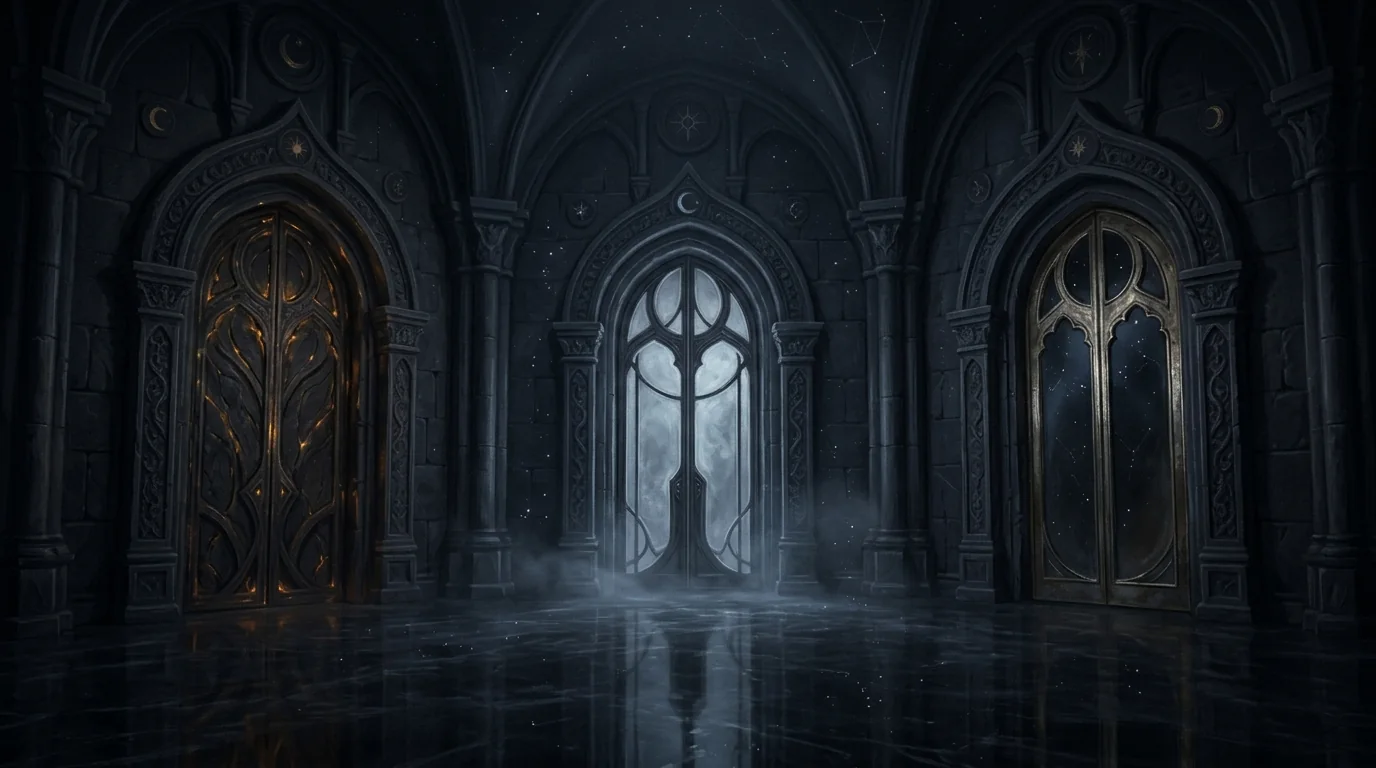
Inside the Theater, your exact card and question carry into a five-act nocturnal walk where you choose between the Door of Ember, the Door of Mist, and the Door of Mirror. By the final act, you leave not only with a one-word polarity, but with a shareable Destiny Card summarizing your posture and next concrete step.
Common Mistakes to Avoid After Pulling a "No" Card
Drawing The Tower or Death in a Yes/No spread can trigger needless panic if read literally. In traditional Rider-Waite-Smith interpretation, neither card predicts doom; both describe unsustainable assumptions clearing away so something honest can stand.
"A 'No' card in tarot is rarely a locked wall—it is a flare illuminating the weak beam before you put your full weight on the bridge."
If a draw returns No, resist the urge to refresh the page until a nicer card appears. Instead, ask one clarifying follow-up inside a 3-card Past-Present-Emerging spread: "What foundation needs repair before I revisit this path?" That single shift turns superstition into disciplined self-reflection—exactly as detailed in our Tri-Oracle methodology and editorial standards.
Try This Framework Directly in Zodiac Traits
Test Your Yes or No Inside the Sanctuary
Step past a one-word verdict. Walk with Wheel of Fortune through the three doors to uncover the timing behind your choice.
Enter Fate Theater NowKey Questions Answered
Can a Yes or No Tarot card answer "Wait" or "Pause" instead of strict Yes or No?
Yes. Zodiac Traits assigns five realistic states—Yes, No, Wait, Pause, and Unclear—across all 78 upright and reversed cards so cards like The High Priestess or The Moon reflect real-world ambiguity accurately.
Why should I not re-draw immediately after getting a "No" in Yes or No Tarot?
Pulling repeatedly until you see a favorable card turns a reflective tool into confirmation bias. Instead, wait 48–72 hours or switch to a 3-card spread to inspect what needs adjusting first.
What is the best way to phrase a Yes or No Tarot question?
Keep it to one action, anchored on your own agency, with a clear timeframe—for example: 'Is pitching this client before the end of the month aligned with my growth?'
Are all 78 Major and Minor Arcana cards included in the Free Yes or No Tarot tool?
Yes. Every draw samples cryptographically from all 22 Major Arcana and 56 Minor Arcana cards (Wands, Cups, Swords, and Pentacles) with a 28% reversal probability.
Related Guides
AI Tarot Reading Guide: How Algorithmic Synthesis & Archetypal Spreads Actually Work
Learn how AI tarot reading combines cryptographic 78-card randomization, 28% reversal probability, and Tri-Oracle synthesis across Tarot, NASA JPL DE421 transits, and Fate Theater.
Read (7 min) →Will I Find Love in 2027? Venus Transits, Eastern Ding-Wei Windows & Love Tarot
Explore 2027 love timing using NASA JPL DE421 Venus transits (zero Venus retrogrades in 2027), Jupiter entering Virgo on July 28, Eastern Ding-Wei windows, and Love Tarot.
Read (7 min) →When Will I Meet My Soulmate? Reading Birth Chart Placements, 2027 Transits & Tarot Timing
Discover how natal Venus, Moon, Mars, and Jupiter transits, synastry aspect scores, Eastern Ding-Wei windows, and Love Tarot reveal when meaningful partnership seasons open.
Read (7 min) →